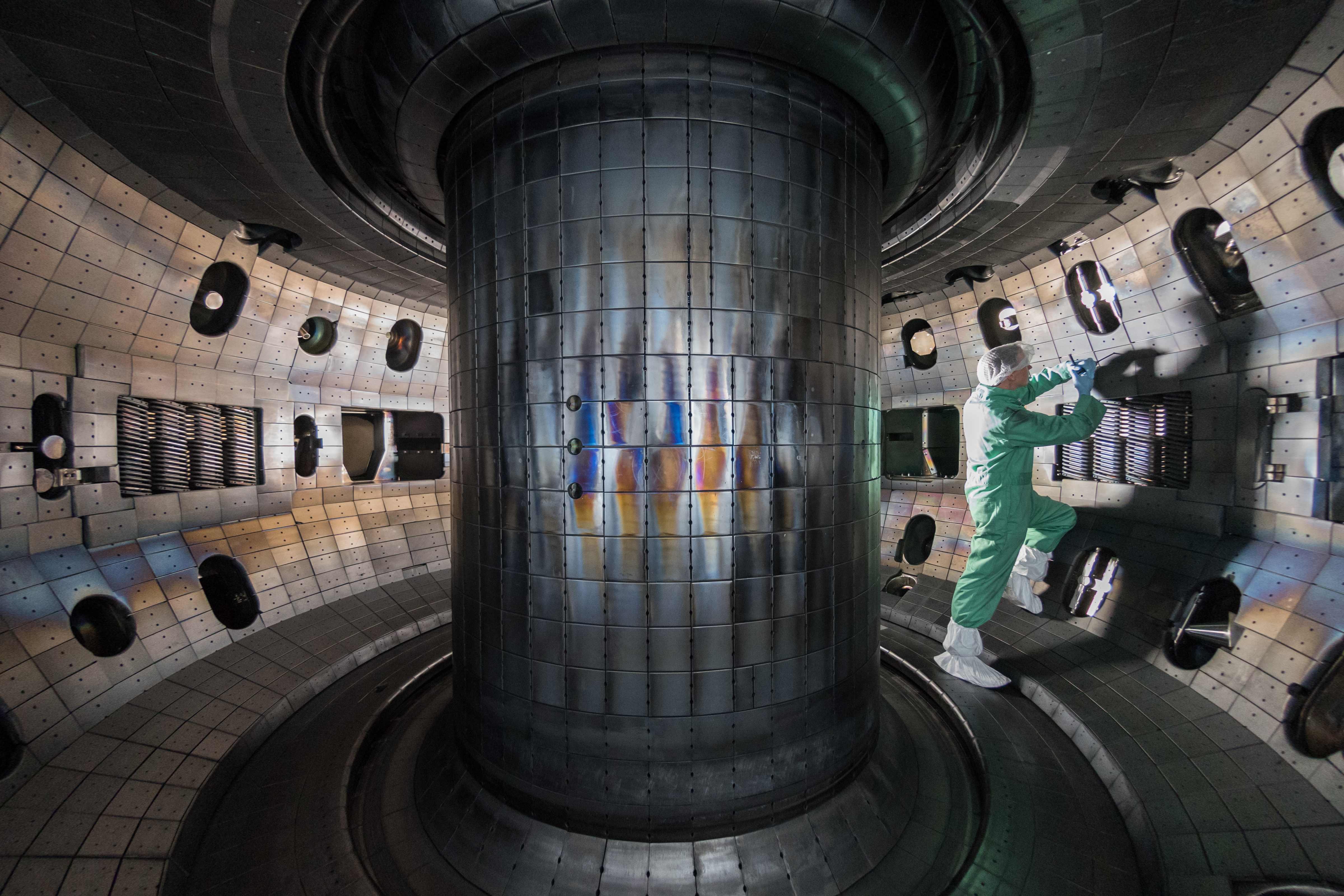
Physicists at the Princeton Plasma Physics Laboratory (PPPL) and Princeton University have demonstrated an artificial-intelligence framework that can read live measurements from a fusion reactor's superheated plasma and issue corrective commands in about 20 milliseconds, roughly ten times faster than a human operator could respond.
The system, called PACMAN (Prediction And Control using MAchiNe learning), links several machine-learning models directly into the control loop of a working tokamak, the donut-shaped device used to confine plasma with magnetic fields. Researchers tested the framework across five separate experiments on the U.S. Department of Energy's DIII-D National Fusion Facility, a tokamak operated by General Atomics in San Diego, tasking it with jobs ranging from coordinating six plasma-heating gyrotrons at once to spotting an instability called a tearing mode before it could tear the plasma apart. In one run, a PACMAN model flagged an oncoming tearing mode roughly 200 milliseconds before it would have appeared, giving operators time to adjust conditions and avoid it entirely rather than reacting after the fact.
That distinction matters because fusion plasmas, heated to well over 100 million degrees Celsius, are prone to small disturbances that can cascade into disruptions capable of damaging the vessel wall within milliseconds, far too fast for a person watching a control panel to intervene. Conventional automated controllers can usually only detect a tearing mode once it has already begun.
Machine learning models can describe the plasma behavior very well, and importantly, they are the only way we have to model the plasma in millisecond times.
Hiro Farre Kaga, Princeton Plasma Physics Laboratory
From one tokamak to many
The findings, published in the journal Nuclear Fusion, describe PACMAN as a modular framework rather than a single fixed program: once the underlying software architecture was built, the team says later models for new tasks took only days to add, compared with months for the first one. That design, detailed in a PPPL announcement, is meant to let the same core system be adapted to tokamaks of different sizes and designs, rather than requiring bespoke control software for every machine.
Independent fusion scientists have welcomed the result as a step toward the kind of real-time, adaptive control that reactors will likely need as they move from research experiments toward net-energy-producing power plants, where disruptions carry higher costs. The PPPL-Princeton team says its next step is testing PACMAN on additional tokamak configurations and expanding the range of instabilities and heating systems it can manage, with an eye toward eventually deploying similar frameworks on future fusion devices not yet built.