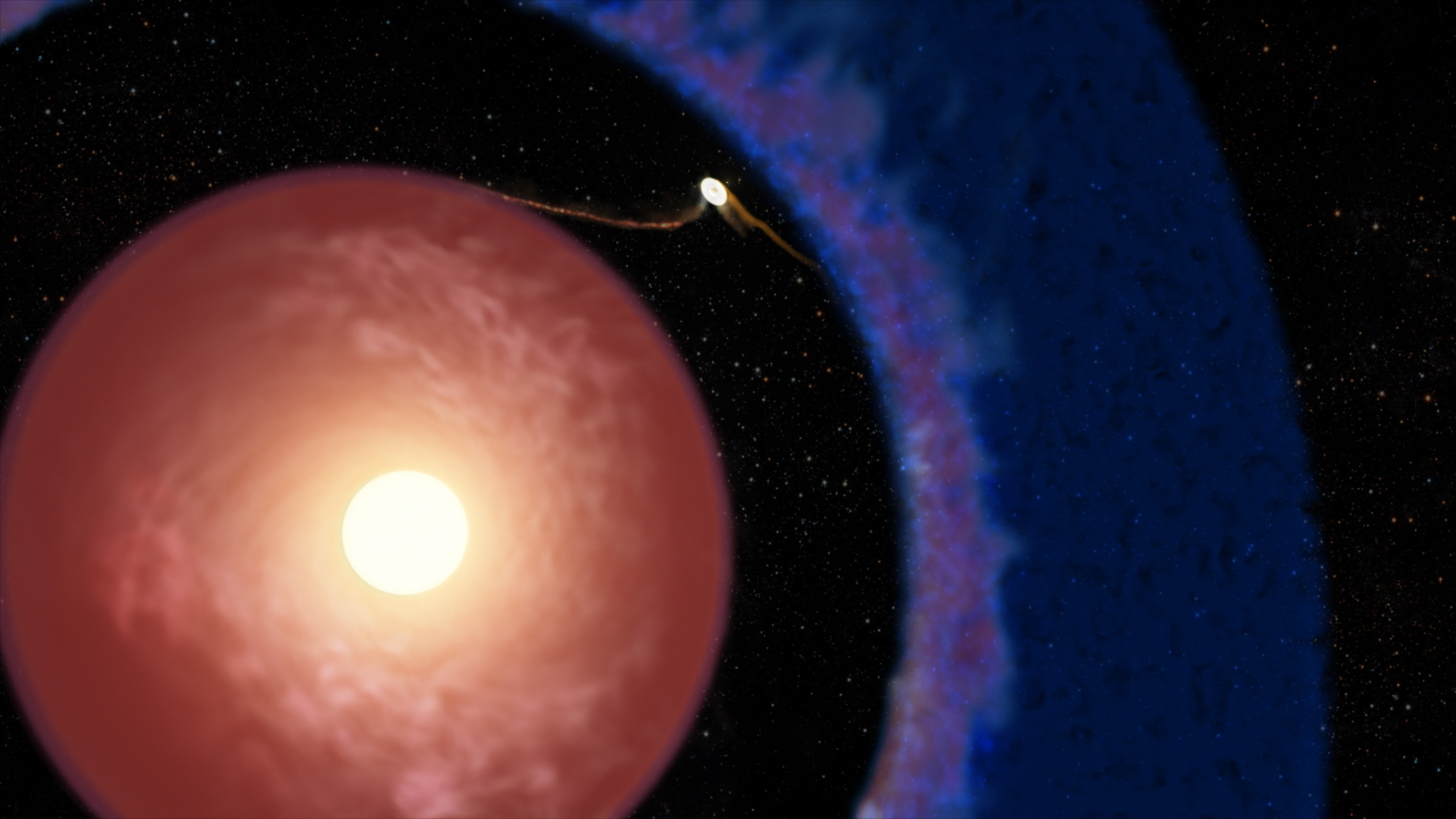
Astronomers have confirmed the youngest planet ever detected outside our solar system: a Jupiter-mass world called Elias 2-24 b that is still forming inside the dusty disk around its infant host star, less than a million years old. The discovery, announced this month, breaks the previous age record by more than a factor of two.
The planet orbits the young star Elias 2-24, about 450 light-years away in the Ophiuchus star-forming region, at a distance of roughly 55 times the Earth-Sun separation — more than ten times farther out than Jupiter sits from the sun. A team led by Andrea Bernardi, a doctoral candidate at Chile's Universidad Diego Portales, identified the planet by reanalyzing 2018 infrared images from the W. M. Keck Observatory in Hawaii with newer data-processing techniques, then confirmed it with additional observations from the Atacama Large Millimeter/submillimeter Array and the European Southern Observatory's Very Large Telescope. The findings were published in The Astrophysical Journal Letters.
A record that strains the models
The previous record holders for youngest confirmed exoplanets — worlds orbiting the stars PDS 70 and WISPIT 2 — are each more than 5 million years old. Elias 2-24 b's age of under 1 million years leaves theorists little time to explain how a planet with roughly Jupiter's mass assembled so far from its star. Standard core-accretion models, in which a solid core slowly gathers gas over millions of years, struggle to work fast enough at that distance; the finding lends support to competing ideas, including gravitational instability, in which clumps of a disk collapse directly under their own gravity.
Elias 2-24 b sits inside a gap in the ring of gas and dust encircling its star — precisely the kind of gap theorists have long predicted a growing planet should carve out, and it appears to still be actively pulling in material.
"Elias 2-24 b shows us that even our best planet-formation models are still missing some important processes."
— Lucas Cieza, Instituto de Estudios Astrofísicos, co-author
The result adds to a small but growing catalog of planets caught in the act of formation, offering astronomers a rare live look at physics usually inferred only indirectly. Bernardi's team says follow-up observations, including from the James Webb Space Telescope, could pin down the planet's temperature and composition and test which formation pathway actually produced it — NASA notes the system will likely become a benchmark case for studying how giant planets take shape at wide separations from their stars.