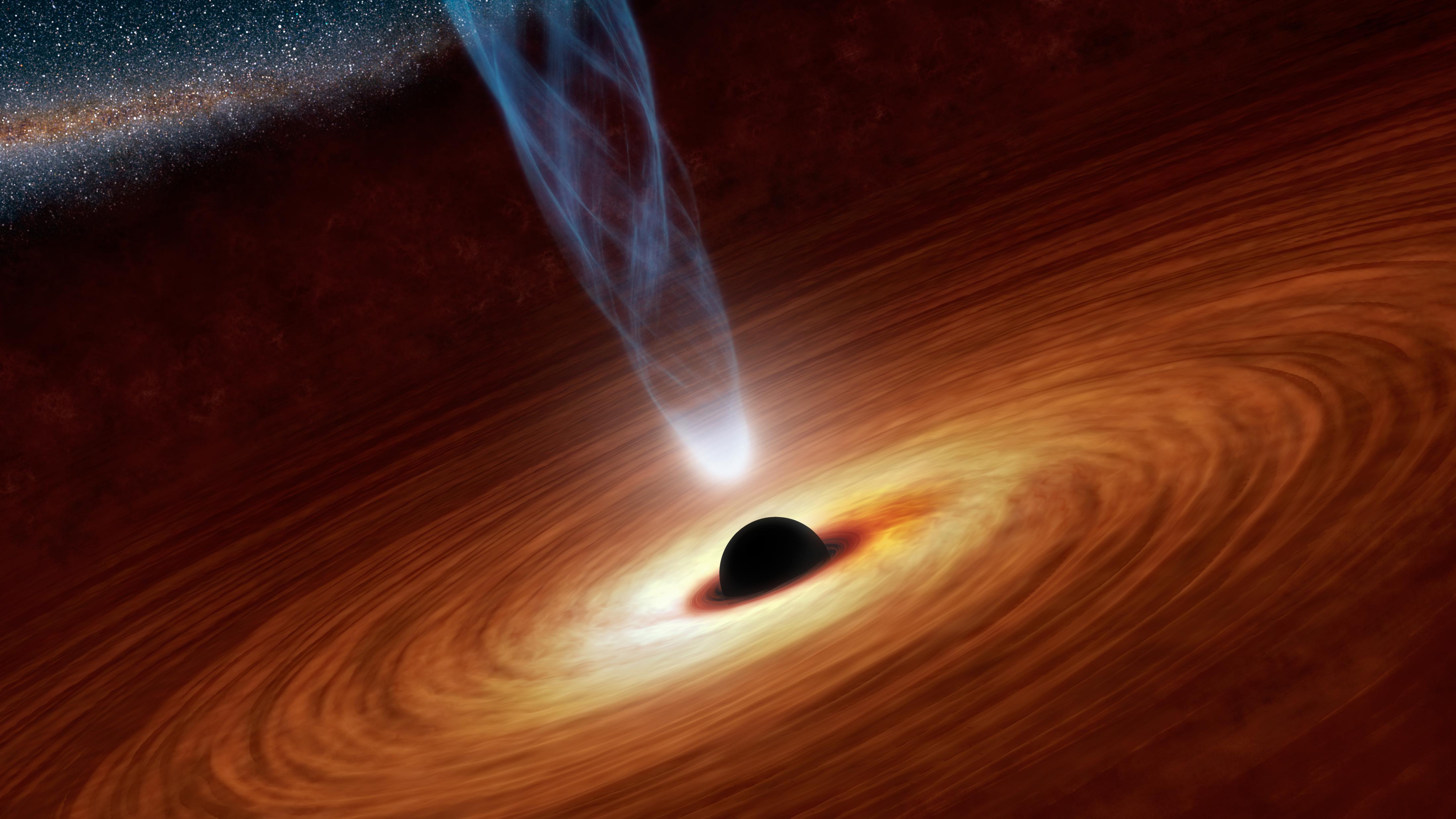
A team of astronomers says it has identified the most tightly spaced pair of actively feeding supermassive black holes yet confirmed from the early universe, separated by only about 175 parsecs — roughly 570 light-years — inside a single distant galaxy.
The system, known as MG B2016+112, sits at a redshift of 3.273, meaning its light set out when the universe was about two billion years old, less than a sixth of its current age. The galaxy happens to lie directly behind an unrelated foreground galaxy whose gravity bends and splits its light into three separate images, labeled A, B and C — a natural magnifying effect astronomers have exploited for decades to study faint, distant objects.
In a preprint posted last month, researchers Jianghao Huyan and Júlia M. Sisk-Reynés, working with Center for Astrophysics | Harvard & Smithsonian astronomer Daniel Schwartz and colleagues, re-examined archival 2018 spectra of the three lensed images taken with the MUSE spectrograph on the European Southern Observatory's Very Large Telescope. They measured the ratios of hydrogen, nitrogen, carbon and helium emission lines in each image and found that image C looks spectroscopically distinct from A and B — evidence, the team argues, that it is powered by a separate ionizing source rather than simply being another lensed copy of the same black hole.
Using the width of the carbon IV emission line, the researchers put lower limits on the black holes' masses at roughly 15 million to 23 million times the mass of the sun. After correcting for how much the foreground galaxy's lensing magnifies the light, they estimate the two black holes are feeding at up to about half the maximum theoretical rate, known as the Eddington limit, while the signal associated with image C suggests much slower growth, around 4%.
Building on earlier clues
The possibility that MG B2016+112 hides two black holes is not new. A 2021 analysis using NASA's Chandra X-ray Observatory had already suggested a pair separated by a similar distance, based on X-ray and radio data. The new spectroscopic work is presented as an independent line of evidence pointing to the same conclusion, rather than a first discovery of the pair.
Pairs of merging supermassive black holes interest astronomers because they are thought to be a natural byproduct of galaxy mergers, and tight pairs like this one are considered likely progenitors of the gravitational-wave signals that future space-based observatories are designed to detect. Confirming genuine dual black holes, rather than lensing artifacts or a single black hole with a misleading jet, has historically been difficult at such large distances.
The findings have not yet completed peer review, and the authors caution that their mass and feeding-rate estimates depend on assumptions about how much the foreground galaxy magnifies each image, which are not perfectly known. The data also cannot confirm whether the two black holes are gravitationally bound to one another. The team is calling for follow-up near-infrared, spatially resolved spectroscopy to independently verify the masses and settle the question.