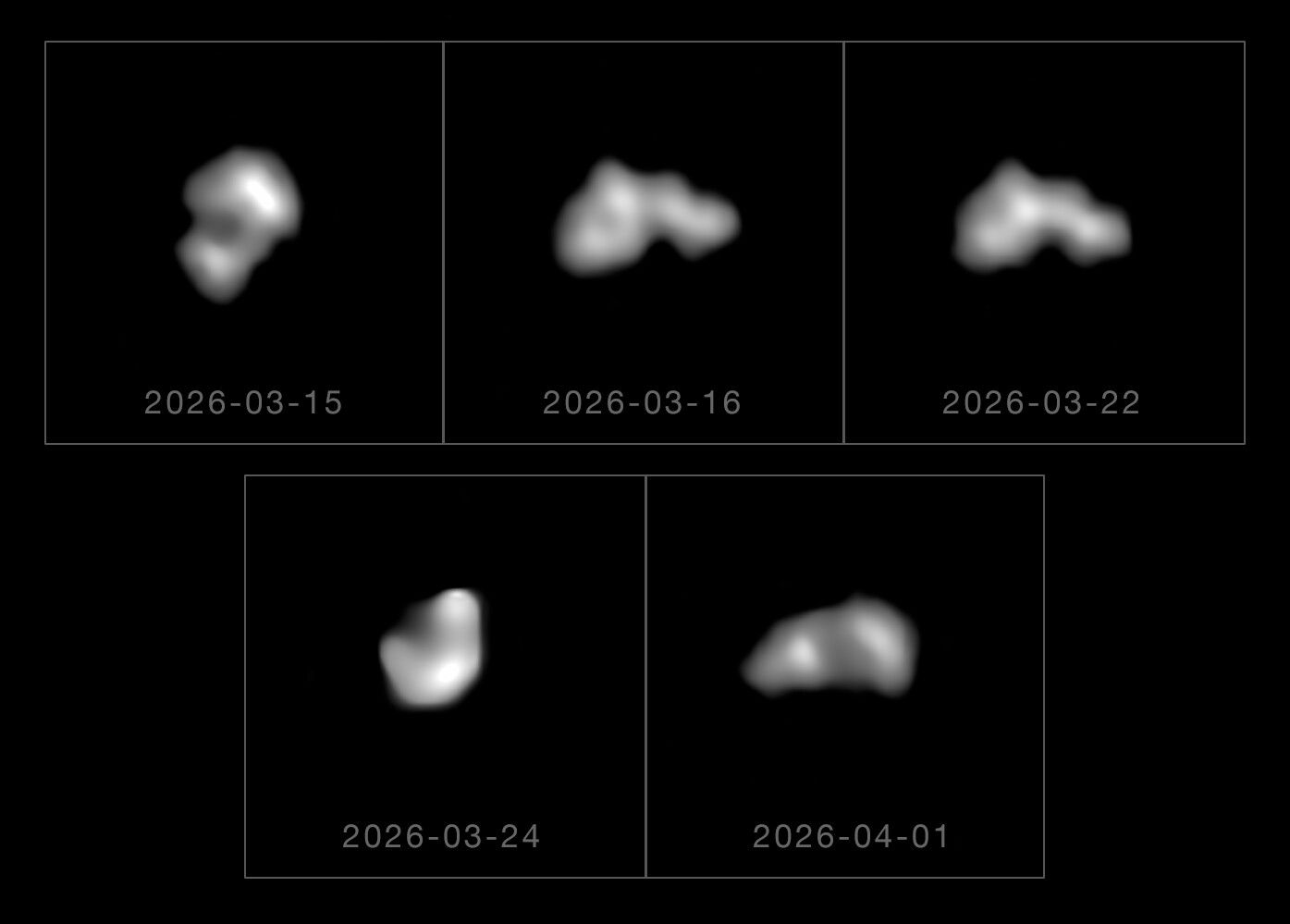
Astronomers have identified what they believe is the first known "three-lobed" asteroid — a main-belt object shaped like three connected spheres joined by narrow necks — along with a previously unknown small moon orbiting it.
The asteroid, designated (44) Nysa, is one of the brightest and largest objects in the main asteroid belt, measuring roughly 80 kilometers, or about 50 miles, across. An international team led by Dr. Kate Minker of Lowell Observatory used two ground-based observatories with adaptive optics to cancel out atmospheric blur: the European Southern Observatory's Very Large Telescope in Chile, using its SPHERE instrument, and the Large Binocular Telescope in Arizona, using the Italian-built SHARK-VIS instrument. The resulting high-resolution images revealed Nysa's unusual trilobate shape — the first of its kind documented, following earlier discoveries of simpler two-lobed "bilobate" asteroids — as well as a small moon, provisionally designated S/2026 (44) 1, roughly half a mile to a mile across.
"The images reveal a remarkably unusual object," Minker said. Nysa, she said, "is either a contact trinary, consisting of three connected components, or an extremely irregular coherent body unlike anything we've previously observed" — meaning the asteroid could be three separate bodies that collided and merged, or a single body severely deformed by repeated impacts over billions of years.
The name is quite fitting... We've managed to finally unmask (44) Nysa.
Dr. Kate Minker, Lowell Observatory
Nysa takes its name from Greek mythology's birthplace of Dionysus, the god associated with masks and theater — a coincidence Minker's team noted after the imaging revealed the asteroid's true, long-hidden shape. The discovery images date to mid-February, though the findings were made public this week, with the study, led by Minker alongside co-authors including Dr. Anthony Berdeu of ESO and Dr. Al Conrad of the Large Binocular Telescope Observatory, set to appear in the journal Astronomy & Astrophysics.
Researchers say further observations are planned to refine the newly discovered moon's orbit and help settle the question of how Nysa's unusual shape formed. If confirmed as a contact trinary, Nysa would offer a rare, close-up example of how multiple smaller bodies can merge into the kind of larger, irregular asteroids that populate the solar system's main belt.