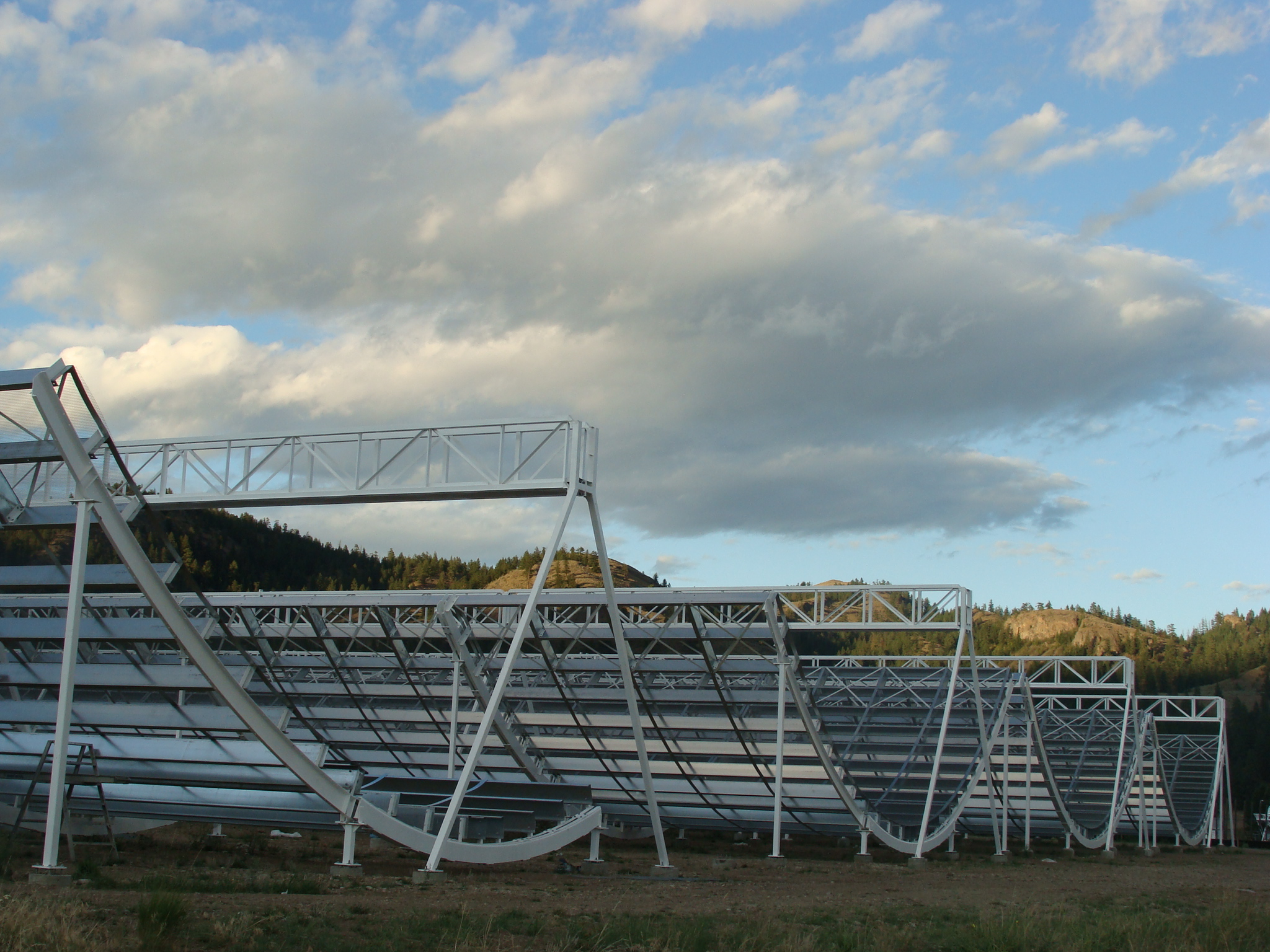
A radio telescope in the hills outside Penticton, British Columbia, has picked out a cosmic signal so faint that it took the team behind it more than a year to convince themselves it was real. The Canadian Hydrogen Intensity Mapping Experiment, known as CHIME, detected the radio glow of hydrogen gas from the distant universe using only its own observations for the first time, rather than cross-checking against outside galaxy catalogs.
Earlier attempts to map this ancient hydrogen relied on comparing radio data with separate galaxy surveys collected by other telescopes, an approach that can cost millions of dollars. CHIME's team instead pulled the signal directly out of 94 nights of observations the instrument gathered in 2019, a method called autocorrelation. The light reaching CHIME's antennas had been traveling for roughly 9 billion years, emitted from an era when the universe was about a third of its current age, when roughly 2% of the universe's hydrogen remained in neutral atomic form — a figure the team says is broadly consistent with other measurements of that period.
A cheaper window on dark energy
The result, published as two companion papers in The Astrophysical Journal, matters because CHIME was built specifically to study dark energy, the unexplained phenomenon thought to be accelerating the universe's expansion. Mapping where hydrogen sits throughout cosmic history lets astronomers reconstruct how that expansion unfolded over billions of years. Doing it with a telescope's own data, instead of pairing it with outside galaxy catalogs, could make the technique far cheaper and let researchers test rival dark-energy models independently of other instruments.
"We worked very hard to convince ourselves that this wasn't a false alarm," said Arnab Chakraborty, a University of Toronto postdoctoral fellow who first proposed looking for the signal in CHIME's existing archive. The team spent more than a year ruling out radio interference from human activity, noise from within the Milky Way, and glitches in the instrument itself before concluding the detection was genuine.
This is a completely new technique for probing the cosmos.
— Mark Halpern, University of British Columbia professor and CHIME principal investigator
CHIME is hosted at the National Research Council of Canada's Dominion Radio Astrophysical Observatory, where it scans the entire northern sky every day using four 100-meter, half-pipe-shaped reflectors. Researchers from the University of British Columbia, McGill University, the University of Toronto and Arizona State University collaborated on the analysis. Simon Foreman, an Arizona State astrophysicist on the team, said the successful detection "opened up a whole new window on the universe" for studying how matter is organized across cosmic time.
The current result draws on only a small slice of CHIME's archive. The collaboration has nearly seven years of additional data banked and plans to push the technique further back, toward an era when the universe was roughly 3 billion years old, to build a longer timeline of cosmic expansion for testing against competing explanations of dark energy.