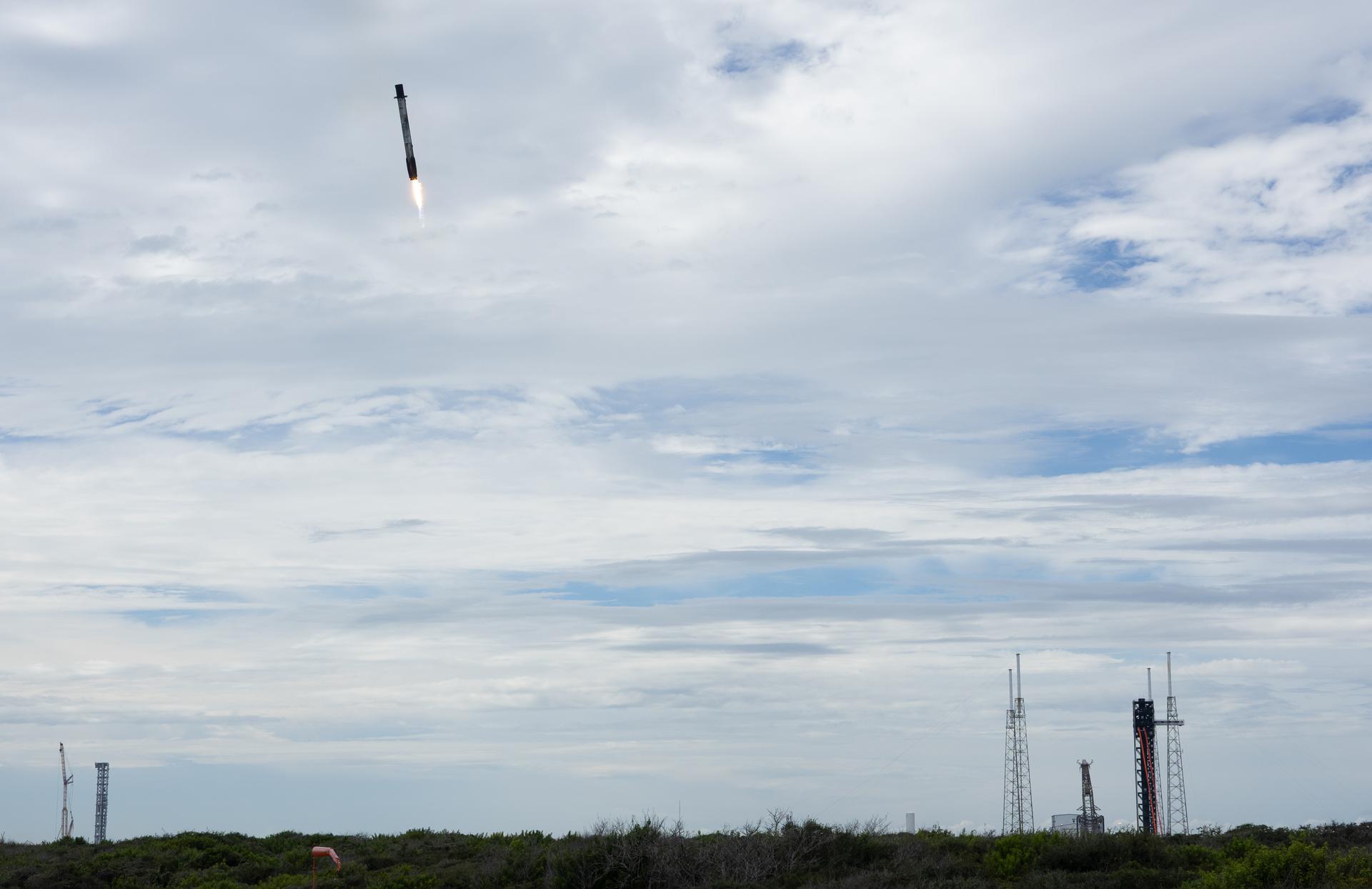
A SpaceX Crew Dragon carrying four astronauts docked at the International Space Station Thursday evening just 7 hours and 55 minutes after launch, the fastest launch-to-docking of a U.S. spacecraft in the history of the station, NASA said.
The Crew-13 mission lifted off at 11:10 a.m. EDT Thursday from Space Launch Complex 40 at Cape Canaveral Space Force Station aboard a SpaceX Falcon 9 rocket, carrying the Dragon spacecraft Grace. The capsule docked at the station's forward-facing Harmony module at 7:05 p.m. EDT, with hatch opening and welcoming ceremonies following shortly after.
Aboard were NASA astronauts Jessica Watkins, the mission commander and a geologist flying her second spaceflight, and Luke Delaney, a former naval aviator making his first trip to orbit as pilot. They were joined by Canadian Space Agency astronaut Joshua Kutryk, a fighter pilot, and Roscosmos cosmonaut Sergey Teteryatnikov, a former submariner, both also flying for the first time.
Crew-13 had originally been scheduled to launch on Sept. 12 but was scrubbed after engineers detected a propellant oxidizer leak in the Dragon capsule. The crew, who had already entered pre-flight quarantine at NASA's Johnson Space Center, went back into isolation on Sept. 17 ahead of the rescheduled launch.
A steadily shrinking commute
The four will join the station's Expedition 75 crew for a stay expected to last roughly six months, carrying out NASA, CSA and Roscosmos research before eventually returning to Earth aboard the same Dragon capsule. It is the 13th crew rotation NASA has flown with SpaceX's Commercial Crew Program since the partnership began ferrying astronauts to the station in 2020, ending NASA's post-shuttle reliance on Russian Soyuz rockets for the trip.
The accelerated rendezvous relies on a launch window timed to line up with the station's orbit almost immediately after liftoff, letting Dragon complete only a handful of orbits before docking rather than the roughly 24-hour approach NASA used for earlier commercial crew flights. Mission managers have gradually shortened that timeline over successive missions as flight controllers gained confidence in the automated rendezvous system, though Thursday's flight was the quickest yet.