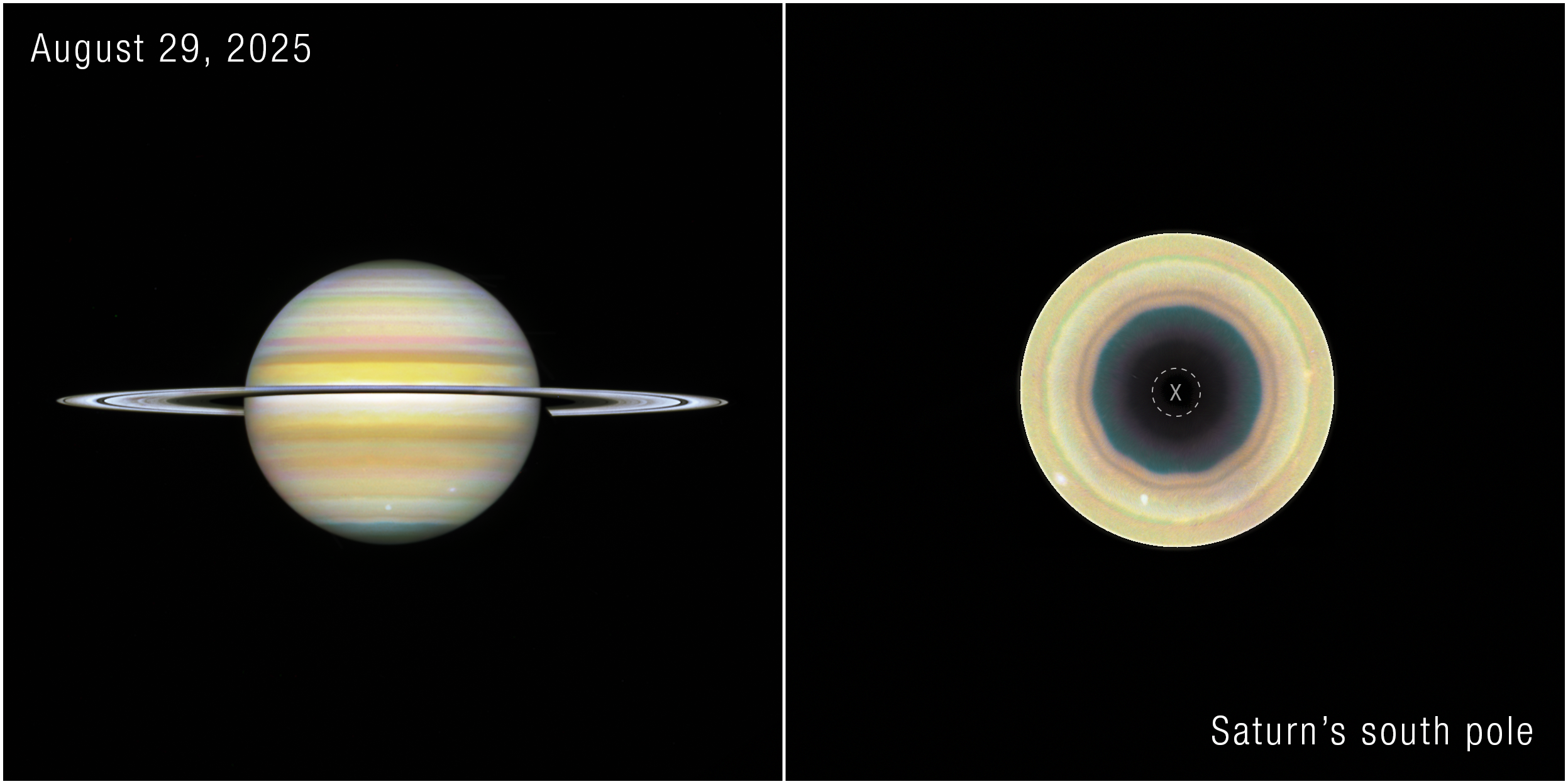
For four decades, Saturn's calling card has been the hexagon — a six-sided jet stream pattern locked around its north pole since the Voyager flybys of the early 1980s. Now the planet has grown an unexpected twin. Astronomers using NASA's Hubble Space Telescope have identified a ten-sided atmospheric wave circling Saturn's south pole, and unlike its stable northern counterpart, this one appears to still be forming.
The decagon spans roughly 104,000 miles across — wide enough to swallow eight Earths side by side — with each of its ten segments stretching about 10,400 miles. It takes roughly 800 days to complete one rotation around the pole. The pattern was first hinted at in ground-based images from 2024 by amateur astronomers working with the Planetary Virtual Observatory and Laboratory, then confirmed and tracked through 2025 using Hubble's Wide Field Camera 3. The findings were published in Science Advances on September 2, led by Agustín Sánchez-Lavega of the University of the Basque Country with NASA and UC Berkeley co-authors.
A new kind of wave
Saturn's axial tilt kept its southern hemisphere hidden from Earth-based view between 2012 and 2023, which is likely why the decagon went unnoticed until recently. Researchers say it probably formed from the same physics that sustains the northern hexagon: a standing atmospheric wave generated where fast jet-stream winds farther from the pole meet slower-moving air closer to it. But where the hexagon has barely budged in shape or position since it was first photographed, the decagon appears to be intensifying — a rare chance to watch a planetary-scale weather pattern develop in something close to real time.
The northern hexagon has been there every time we've looked for more than 40 years. This feature is different — it appears to be strengthening, giving us the rare opportunity to watch a giant atmospheric pattern develop.
Amy Simon, NASA Goddard Space Flight Center
The observations come from Hubble's long-running Outer Planet Atmospheres Legacy program, which has tracked seasonal change on the solar system's gas and ice giants for more than a decade. That steady cadence of imaging is what allowed scientists to notice the decagon strengthening year over year rather than dismissing it as a one-off artifact.
Researchers caution the decagon's long-term fate is unknown. It could stabilize into a fixture as durable as the hexagon, gradually dissipate, or continue changing shape as Saturn's seasons progress — the planet takes nearly 30 Earth years to orbit the sun, and its south pole is only now emerging back into sunlight and telescope view after over a decade in winter darkness. Scientists have not yet nailed down why the pattern favors ten sides rather than six, seven, or another number.
Follow-up observations are planned with both Hubble and the James Webb Space Telescope to track whether the wave keeps sharpening or begins to fade, and to probe deeper into the cloud layers to understand what is driving it.