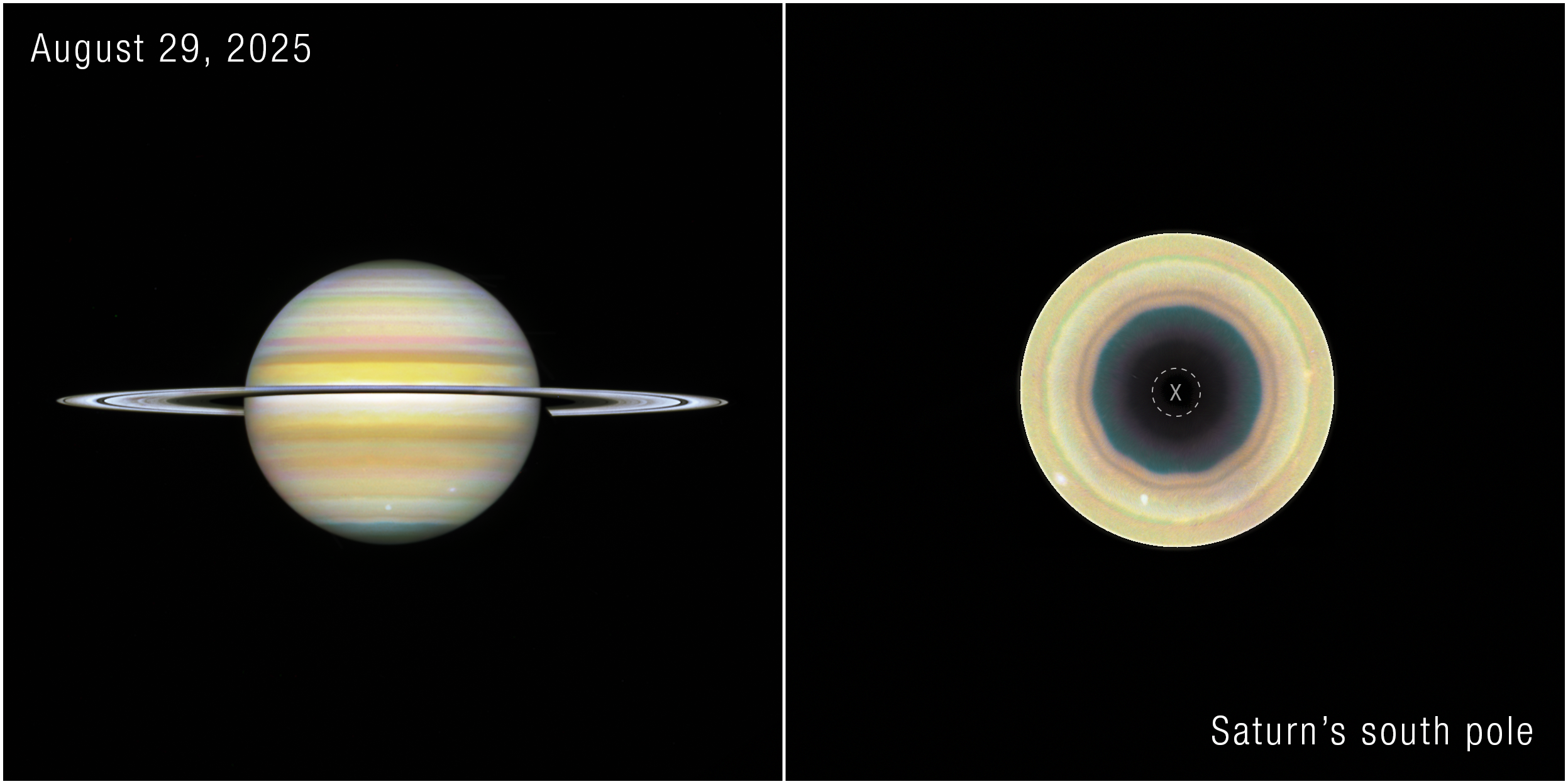
NASA's Hubble Space Telescope has confirmed a giant, ten-sided wave of cloud circling Saturn's south pole, a geometric feature astronomers say has no known precedent in the planet's southern hemisphere. The discovery, announced by NASA this week, was published September 2 in the journal Science Advances.
The decagon extends through multiple layers of Saturn's atmosphere and sits inside one of the planet's fast-moving jet streams. Researchers first noticed hints of the pattern in Hubble images from 2023, and ground-based observations gathered by amateur astronomers Trevor Barry and Jean-Paul Oger in 2024 and 2025 helped the team confirm that a real, evolving structure was taking shape rather than an imaging artifact. By comparing years of Hubble data, the researchers determined the feature has grown steadily more distinct.
Saturn has carried a six-sided jet-stream pattern around its north pole, the famous hexagon, for more than four decades. First identified by NASA's Voyager spacecraft in the early 1980s and since tracked in detail by the Outer Planet Atmospheres Legacy program, the northern hexagon has proven remarkably stable, retaining its shape and position year after year. The new southern decagon behaves differently: rather than settling into a fixed form, it appears to still be developing.
A Rare Chance to Watch a Storm Take Shape
"The northern hexagon has been there every time we've looked for more than 40 years. This feature is different — it appears to be strengthening, giving us the rare opportunity to watch a giant atmospheric pattern develop," said Amy Simon of NASA's Goddard Space Flight Center, principal investigator for the OPAL program, in NASA's announcement. Lead author Agustín Sánchez-Lavega of the University of the Basque Country, who has searched Hubble archives for a southern counterpart to the hexagon since 1990, said the team was struck by how recently the structure seems to have formed.
Scientists do not yet know what triggered the decagon's appearance or what shape it will ultimately settle into, if any. Saturn's polar jet streams are driven by complex interactions between the planet's rotation, deep atmospheric winds and periodic storms, and modeling such systems is difficult even with detailed imagery. The research team, which also included planetary scientist Michael Wong of the University of California, Berkeley, says the decagon's multi-layered structure suggests it is tied to deeper atmospheric dynamics rather than a surface cloud effect alone.
Researchers plan to keep monitoring the feature with Hubble and the James Webb Space Telescope in the coming years, along with computer modeling meant to reproduce the conditions that could generate a ten-sided standing wave. Whether the decagon strengthens into a lasting fixture like its northern counterpart, or fades as suddenly as it appeared, should become clearer as more observing seasons pass.