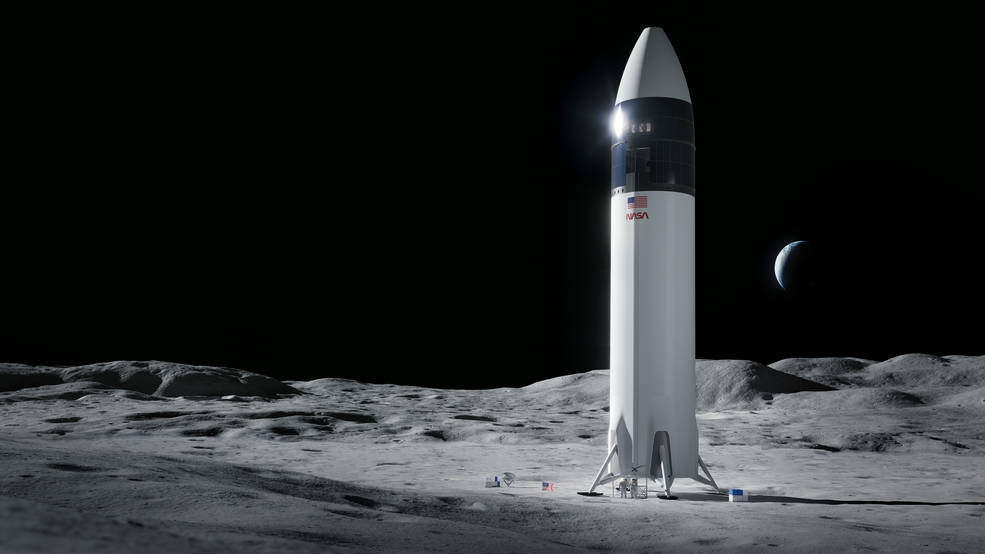
NASA laid out in unusual detail Friday how it now plans to land astronauts on the Moon under the Artemis program, acknowledging significant changes to the mission architecture for both of its commercial lander partners, SpaceX and Blue Origin, while still pointing to a 2028 landing date for Artemis IV.
The biggest shift involves SpaceX's Starship. NASA canceled its planned Lunar Gateway space station earlier this year, which eliminated the need for Starship to dock with the Orion crew capsule in a distant near-rectilinear halo orbit around the Moon — a maneuver that demanded more energy and carried its own technical headaches. Under the revised plan, SpaceX will instead fuel a Starship lunar lander in low-Earth orbit before it docks with Orion in high-Earth orbit; the crew will then fly to the Moon inside Orion before two of the four astronauts transfer into Starship for the actual landing.
Refueling Math Still in Dispute
How many tanker launches that approach requires remains genuinely unsettled. A NASA Safety Panel reported this week that the current estimate is roughly 22 refueling launches to top off a Starship for a lunar mission, a figure SpaceX founder Elon Musk has publicly disputed, saying the real number will be six to eight. NASA officials declined during Friday's question-and-answer session to commit to a precise figure, citing uncertainty in Starship's lift capacity and how much cryogenic methane and liquid oxygen will boil off while the vehicle waits in orbit.
Blue Origin's architecture also changed, though less dramatically. The revised plan calls for four launches of the company's New Glenn rocket but eliminates any spacecraft-to-spacecraft refueling, and leaves open the possibility that Blue Origin's Blue Moon lander could rendezvous with Orion in low-lunar orbit rather than farther out.
A Tight but, Officials Say, Achievable Schedule
NASA said it still anticipates launching Artemis III — a demonstration mission involving docking with both the Blue Moon and Starship landers near Earth, without an actual lunar landing — by "summer" 2027, with Artemis IV, the mission that would put astronauts on the lunar surface, still tracking toward 2028. "This is an achievable path we are on right now," NASA Administrator Jared Isaacman told reporters. "We have the mandate, we have the resources, and the support from our stakeholders to be able to execute, and that's what we intend to do."
Isaacman's team has spent much of the year reworking Artemis's architecture in an effort to help both lander companies simplify their paths to the Moon, but the unresolved refueling math for Starship, and the sheer number of launches either architecture ultimately requires, leave real room for the 2027 and 2028 target dates to slip, as earlier Artemis milestones have repeatedly done before.