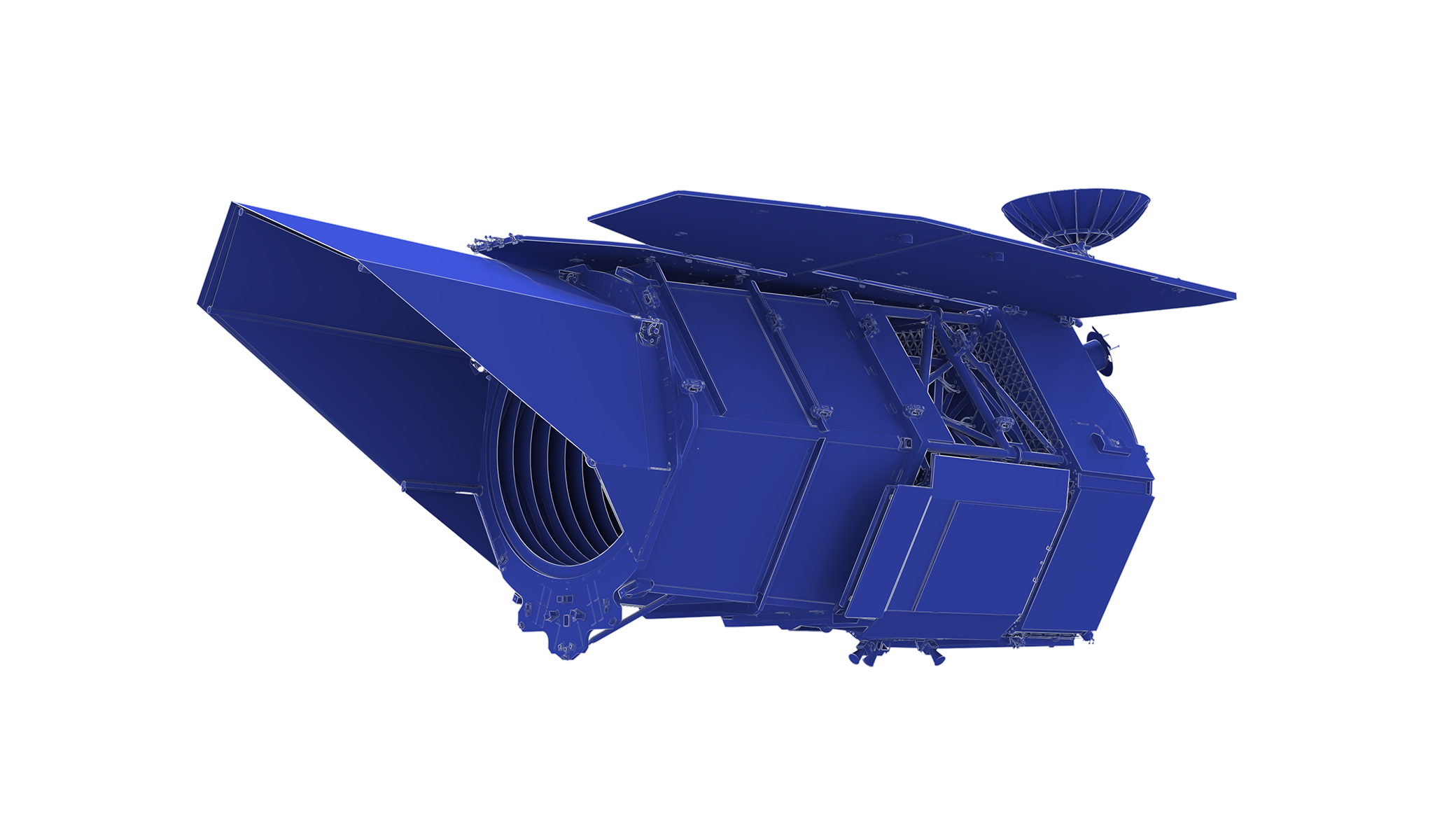
Three weeks after launching atop a Falcon Heavy rocket, NASA's Nancy Grace Roman Space Telescope has passed an early test of the fine-guidance system it will depend on to hold steady on distant targets, the agency reported this week. Separately, its planet-hunting Coronagraph Instrument captured its first test images of a star roughly 160,000 light-years away.
During tests conducted September 15 through 21, Roman's guidance system held its pointing steady to better than 1/100,000 of a degree — for 30-minute stretches while using its Wide Field Instrument and for eight-hour stretches during coronagraph operations. NASA described the precision as roughly equivalent to focusing a laser beam on a U.S. dime from 150 miles away, with engineers aiming to push that to 230 miles as commissioning continues.
"The fine-guidance system reports the positions of the guide stars about four times each second to the attitude control system," said Begoña Vila, Roman's guiding systems lead at NASA's Goddard Space Flight Center. Unlike most space telescopes, which track a star's point-like position, Roman's system also reads detailed spectral patterns, borrowing data the observatory already collects for its science instruments to steady its aim.
On September 22 and again on September 27, Roman's coronagraph captured images of a star in the Large Magellanic Cloud, a satellite galaxy of the Milky Way, to confirm the instrument could form a focused image. "This observation confirms that the instrument can produce a focused image," said Vanessa Bailey, the coronagraph's instrument scientist at NASA's Jet Propulsion Laboratory.
Still months from first science
The coronagraph is designed to block the glare of a host star so the telescope can directly image faint planets orbiting nearby; NASA says it should eventually outperform earlier coronagraphs roughly a hundredfold once fully calibrated, a capability discussed in detail by Aerospace America. But the September tests were only an early checkpoint in a months-long commissioning process. NASA has said Roman is not expected to begin science operations, including its first released images, until around early 2027, after the observatory settles into its orbit near the Sun-Earth L2 point roughly 1 million miles from Earth.
Once operational, Roman is designed to survey a patch of sky 100 times larger than the Hubble Space Telescope can capture in a single image, using a 2.4-meter mirror — the same size as Hubble's — paired with a 300-megapixel detector. Its science goals include surveying thousands of exoplanets, probing the nature of dark energy, and testing whether its coronagraph technology, NASA's first flown on an active space telescope, can inform the design of future missions built to search for Earth-like worlds.