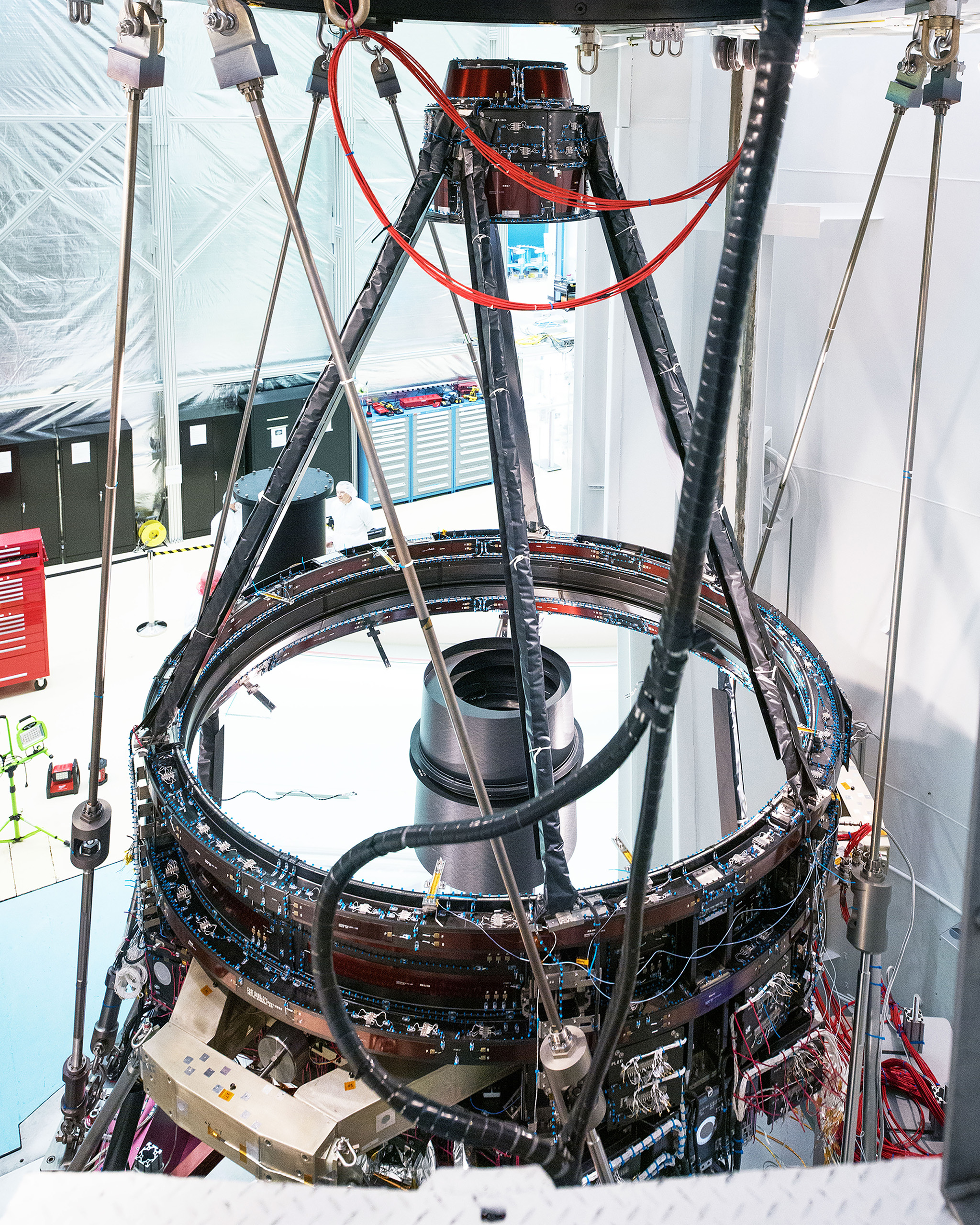
NASA's Nancy Grace Roman Space Telescope has switched on its primary science camera and captured its first photons of real starlight, a milestone the agency says confirms the instrument survived launch and is working roughly a million miles from Earth. The Wide Field Instrument began cooling on September 11 after its protective heater was switched off, dropping from about minus 85 degrees Fahrenheit to its operating temperature near minus 300 degrees Fahrenheit.
The resulting test image, released publicly on September 21, shows hundreds of stars rendered as glowing green rings rather than sharp points of light. That is expected: the 300-megapixel detector array was still in its launch-stowed position, far from best focus, so light from each star spread across thousands of pixels. NASA engineers said the ring shape comes from the telescope's mirror design, in which a secondary mirror mounted in front of the primary blocks the center of the incoming light.
18 detectors, one giant field of view
The camera's 18 infrared detectors together cover an area of sky larger than the apparent size of a full moon in a single exposure — roughly 100 times the field of view of the Hubble Space Telescope, while aiming for comparably sharp images once focused. Roman launched on September 1, 2026, and is the latest in NASA's line of flagship observatories, designed to survey dark energy, map the distribution of matter across the universe, and search for exoplanets.
There is much to do, but we are on our way to groundbreaking science.
Josh Schlieder, Wide Field Instrument scientist, NASA Goddard Space Flight Center
Roman is not alone in the current wave of observatory milestones; its activation follows a busy September for space agencies, with the first cosmic light announcement drawing comparisons to earlier Hubble and Webb startup sequences, both of which also returned blurry test images before reaching full focus.
NASA says the instrument now enters a roughly 30-day decontamination period, followed by activation of the fine-guidance system and a lengthy process of aligning and focusing the telescope's optics. If that timeline holds, Roman is expected to begin returning its first full, in-focus science images in early 2027, kicking off a mission designed to run for at least five years.