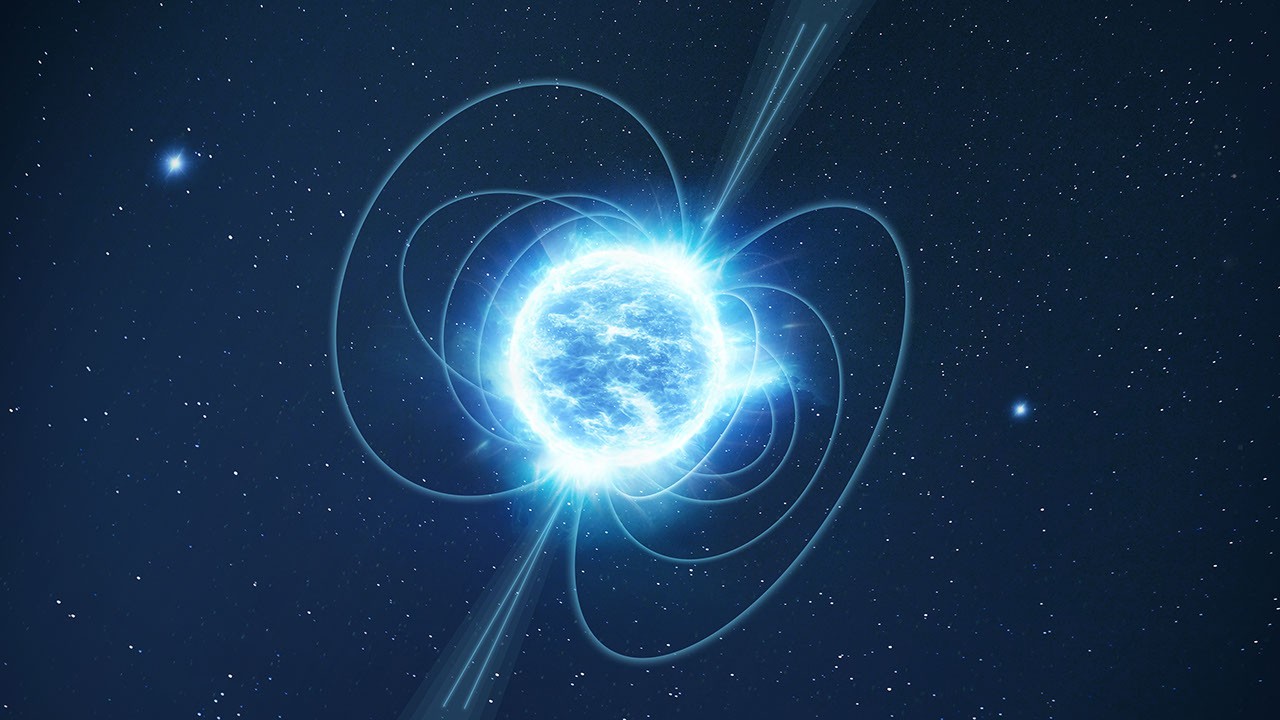
A burst of X-rays that lingered for nearly ten minutes — far longer than astronomers thought possible from a neutron star merger — is offering the clearest evidence yet that these collisions can leave behind a magnetar, one of the most magnetically extreme objects in the universe.
The event, cataloged as GRB 250704B/EP250704a, was first spotted on July 4, 2025, when China's Einstein Probe satellite and the French-Chinese SVOM mission independently picked up a short gamma-ray burst lasting less than a second. What followed was unusual: rather than fading immediately, the source kept emitting X-rays for close to 10 minutes, dwarfing the brief flickers typically seen after such bursts.
Follow-up spectroscopy with the European Southern Observatory's Very Large Telescope placed the explosion at a redshift of 0.661 — more than 6 billion light-years away — making the prolonged glow even more remarkable given the distance. Researchers, whose findings appear in the journal Science Bulletin, argue the prolonged X-rays are best explained by a newly formed magnetar — a neutron star with a magnetic field roughly a quadrillion times stronger than Earth's — pumping energy into its surroundings as it spins down.
"If the remnant of the collision is a magnetar, it could keep bursting for longer. Magnetars are rapidly spinning neutron stars with huge magnetic fields."
Eleonora Troja, University of Rome Tor Vergata
"This is the longest lasting prompt X-ray flash ever observed from a neutron star merger."
Niccolò Passaleva, University of Rome Tor Vergata
Ruling Out Other Explanations
The team used the Very Large Array and multiple space telescopes, including China's Insight-HXMT, to track the afterglow across radio, optical and X-ray wavelengths. Crucially, they found no trace of a supernova — the kind of explosion expected if the X-rays instead came from the collapse of a massive, dying star. That absence strengthens the case that two neutron stars, not one massive star, produced the signal.
The finding matters because astronomers still don't know how often neutron-star mergers leave behind a magnetar rather than collapsing straight into a black hole, a detail that shapes how matter and gravitational waves are released in the process. The researchers say they now want to catch a similar X-ray flash alongside a gravitational-wave detection from the same merger, which would let them pin down the fate of colliding neutron stars far more precisely. No such joint detection has been made yet, and the magnetar interpretation, while well-supported by the data, remains an inference rather than a direct observation of the remnant itself.