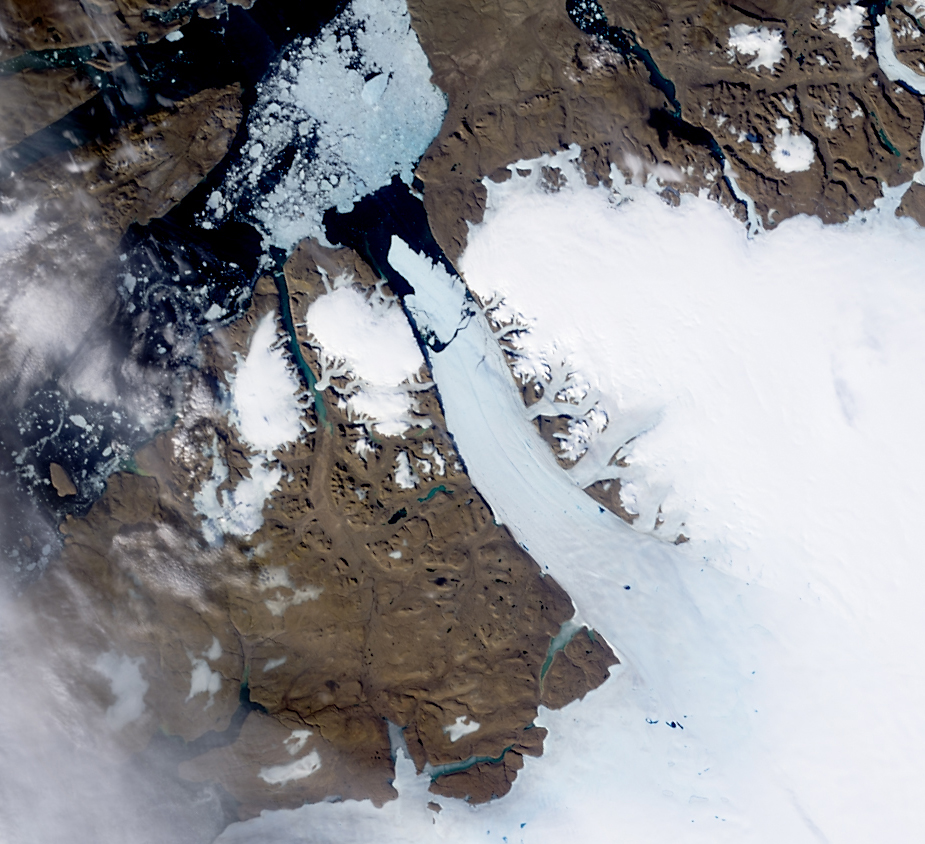
A newly calved iceberg more than 76 square kilometers — roughly the size of Manhattan — broke free from Greenland's Petermann Glacier in early August and collided with a small landmass called Joe Island later in the month without breaking apart, glaciologists tracking the event said.
The ice island separated from the glacier's floating tongue on Aug. 4, following a fracture line researchers had not expected. "What surprised us was that the calving instead followed a different fracture, producing a smaller ice island than we had originally anticipated," Adam Garbo, a University of Ottawa doctoral student who has monitored the glacier by satellite, said in comments reported this month. Independent tracking by glaciologist Mauri Pelto of Nichols College, published on his glacier-monitoring blog, put the fragment at roughly 75 square kilometers and confirmed it as the largest iceberg to calve anywhere in the Northern Hemisphere so far in 2026.
A slow-motion collision
Drifting southwest through Petermann Fjord toward Nares Strait at roughly 3 kilometers a day, the berg struck Joe Island around Aug. 23-24, an event captured in NASA-USGS Landsat imagery. Rather than shattering on impact, as many thinner icebergs do, the mass held together. "We were certainly watching closely as it interacted with Joe Island and were impressed that it survived the interaction," Garbo said.
Petermann Glacier, one of Greenland's largest floating ice tongues, has calved several major ice islands over the past two decades, including a 130-square-kilometer fragment in 2012 and a piece exceeding 250 square kilometers in 2010. Researchers say two additional rifts already visible in the glacier are likely to produce further ice islands of roughly 94 and 84 square kilometers in the coming years, part of a retreat scientists attribute to warming water beneath the floating ice shelf.
Scientists plan to keep tracking the fragment using European Space Agency and NASA satellites as it continues drifting toward Baffin Bay, where large Petermann-sourced ice islands have historically taken months to break down, occasionally drifting far enough south to threaten shipping lanes.