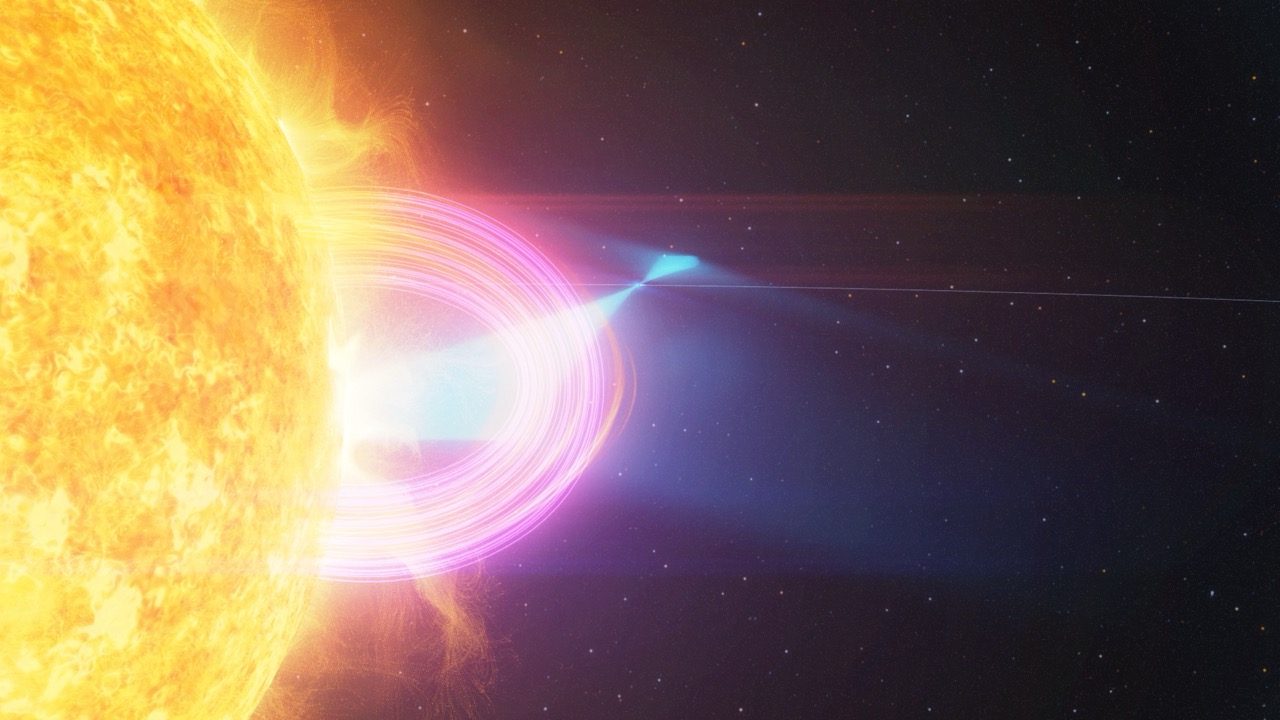
A research team at Curtin University's node of the International Centre for Radio Astronomy Research (ICRAR) says it has identified a stellar pairing nobody had seen before: a white dwarf — the dense, burned-out core left behind when a star dies — spinning once every eight minutes while orbiting a G-type star much like the Sun, more than 5,000 light-years from Earth. It's the first time a radio-pulsing white dwarf has been found paired with a Sun-like companion rather than a smaller, cooler red dwarf.
The system, designated GPM J071507−114153, belongs to a rare and still poorly understood class of objects called long-period transients (LPTs) — sources that switch radio emission on and off over minutes to hours, rather than the millisecond-to-second rhythms of ordinary pulsars. The same ICRAR team found the first known LPT in 2021; roughly a dozen have turned up since, and astronomers have struggled to pin down which star in each pair is actually producing the signal.
Watching the White Dwarf Move
This time, more than 100 hours of radio data — gathered with the Murchison Widefield Array in Western Australia and refined with the MeerKAT telescope in South Africa, then processed at the Pawsey Supercomputing Research Centre — were detailed enough to track the white dwarf's own orbital motion. "This is the first time the pulses are clear enough to see the white dwarf moving in its orbit around its companion, so we know that the pulsations are coming from a region close to the white dwarf, or possibly even from the white dwarf itself," said lead author Dr. Sam McSweeney, now a commissioning scientist with the Square Kilometre Array Observatory.
The radio pulses also gave the team an unplanned way to study the companion star. Co-author Associate Professor Natasha Hurley-Walker said the observations caught stellar flares and what was likely a "stellar prominence" — a loop of magnetized plasma erupting from the companion's surface — as the white dwarf passed behind it. "It's amazing that by using radio wavelengths we can detect the storms on a star over 5,000 light-years away," she said. The W.M. Keck Observatory in Hawaii later confirmed the companion's identity as a Sun-like star through separate optical observations.
Both the Murchison Widefield Array and MeerKAT are considered precursor instruments for the still-under-construction Square Kilometre Array telescopes, which researchers expect to turn up many more of these long-period systems once they are operating at full strength.