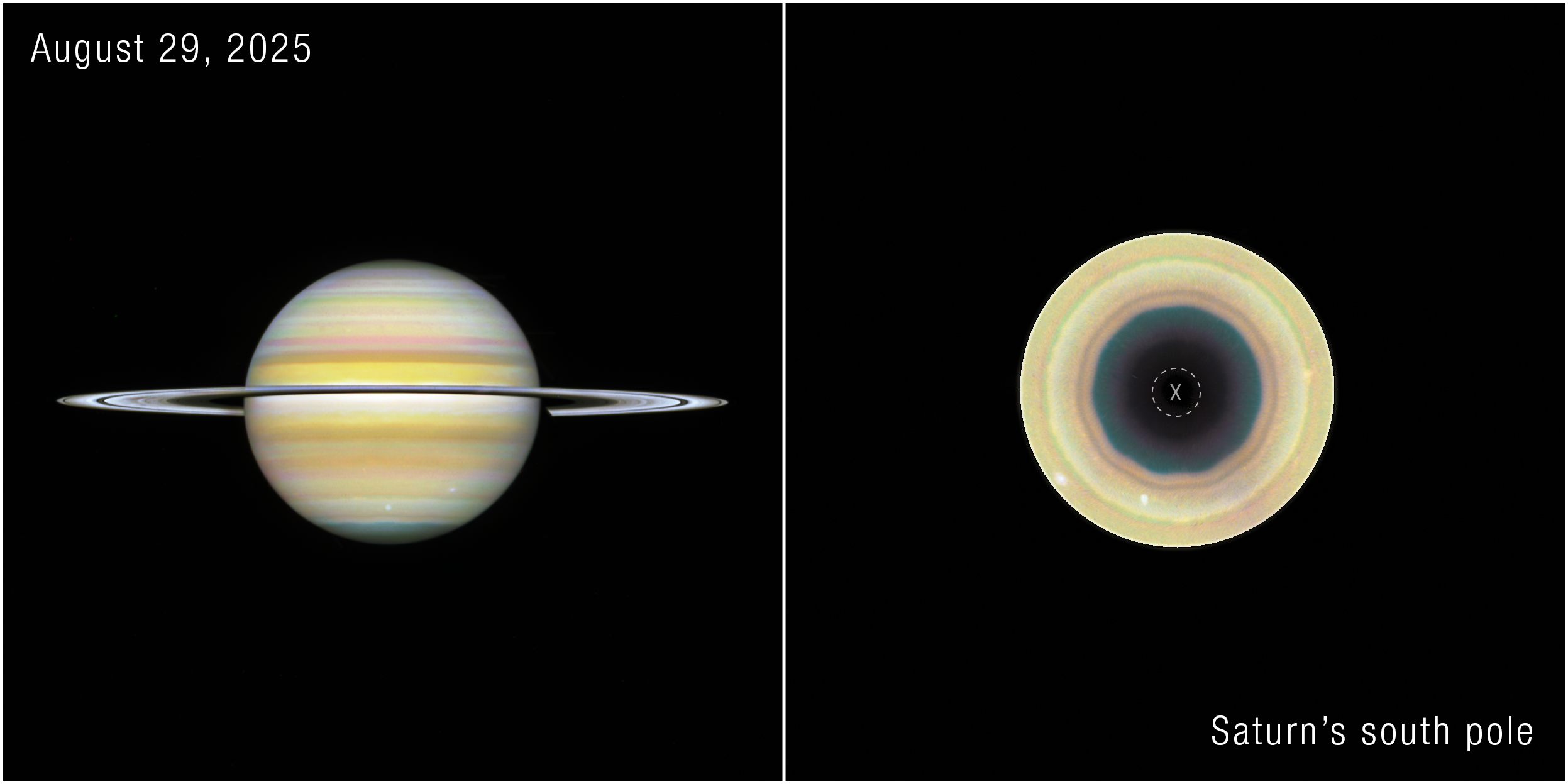
Astronomers using the NASA/ESA Hubble Space Telescope have identified a giant, ten-sided wave pattern circling Saturn's south pole, a feature researchers are calling a "decagon." The finding, announced this month by NASA and the European Space Agency's Hubble team, marks the first time a large, regular-sided jet-stream pattern has been documented in the planet's southern hemisphere.
The decagon spans roughly 104,000 miles across, with each of its ten sides measuring about 10,400 miles. It sits embedded within one of Saturn's high-speed atmospheric jet streams and appears to extend through multiple layers of the atmosphere, suggesting it is a deep, three-dimensional structure rather than a surface cloud feature. Researchers estimate the pattern takes roughly 800 days to complete one rotation around the pole.
Absent From Cassini's 13-Year Watch
What makes the discovery notable is timing. NASA's Cassini spacecraft orbited Saturn continuously from 2004 to 2017 and photographed the planet's poles repeatedly, yet recorded no sign of a long-lived decagon. By piecing together Hubble images gathered under its Outer Planet Atmospheres Legacy program, along with observations from amateur astronomers Trevor Barry and Jean-Paul Oger, scientists traced the feature's emergence back to at least 2023, with the pattern growing more distinct in the years since.
"We've never seen anything quite like this in Saturn's southern hemisphere," said Amy Simon, principal investigator of the OPAL program at NASA's Goddard Space Flight Center. Planetary scientist Agustín Sánchez-Lavega of the University of the Basque Country led the study, published Sept. 2 in the journal Science Advances.
The decagon invites comparison to Saturn's better-known northern hexagon, a six-sided jet-stream pattern first documented by Voyager spacecraft roughly four decades ago and still circling the north pole today. Both features are thought to arise the same way: as standing waves that form when fast-moving polar jets interact with slower currents nearer the pole. Simulations of shallow, rotating fluids support the idea that a meandering wave trapped within a curving jet stream can lock into a stable polygon, though scientists don't yet know why Saturn's south pole produced ten sides rather than six, or why now.
Researchers plan to keep monitoring the feature with Hubble as Saturn's slow, 29-year orbit continues turning the planet's south pole toward Earth-based instruments after years hidden from view. Continued observations should show whether the decagon is a passing disturbance or, like its northern counterpart, a durable fixture of Saturn's atmosphere.