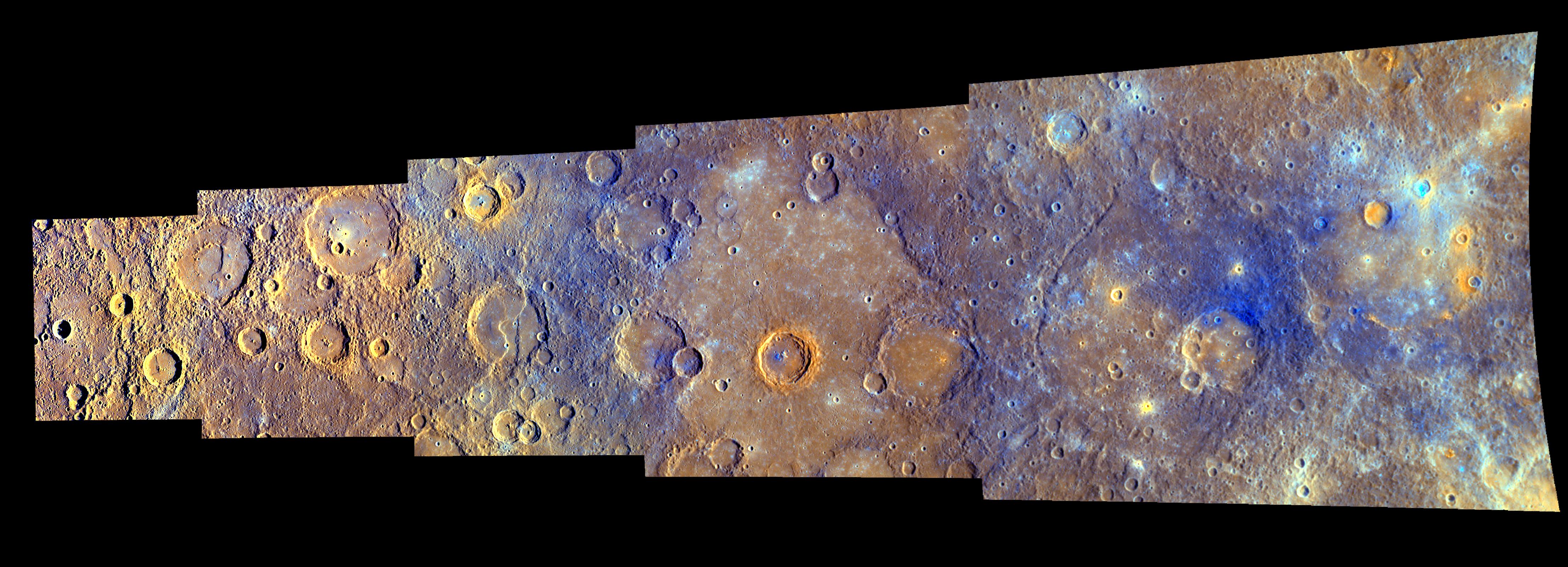
Mercury has shrunk substantially more than planetary scientists had calculated, according to a study published Sept. 10 in Geophysical Research Letters that identifies a measurement blind spot hiding much of the planet's contraction from view.
The new analysis, led by planetary scientist Gaku Nishiyama of the German Aerospace Center's Institute of Space Research, finds Mercury has contracted 10 to 30 percent more than earlier estimates suggested, translating to a total diameter loss of up to 23 kilometers (about 14.5 miles) since the planet formed roughly 4.5 billion years ago. Earlier work based on NASA's MESSENGER spacecraft data had put the figure at just 4 to 16 kilometers.
Mercury's surface is crossed by long, cliff-like ridges called lobate scarps, wrinkles that form as the planet's interior cools and its rocky shell buckles inward, much like a grape shriveling into a raisin. Nishiyama's team found that in areas roughened by overlapping impact craters and old lava flows, these contraction scarps become harder to detect and get systematically undercounted. "It made us think that there's a process obscuring shortening structures," Nishiyama said, describing how surface clutter masks the true scale of shrinkage in the rockiest terrain.
The revised figures matter because they bring Mercury's observed contraction closer in line with what physics-based cooling models predict for a planet with its iron-rich interior. A bigger contraction implies Mercury's metallic core is likely larger, contains fewer light elements such as silicon than assumed, or started out hotter than previous models assumed, Nishiyama said. Mercury's core takes up roughly 85 percent of its radius, far more proportionally than Earth's, making the planet something of an outlier in solar system formation theories.
More shrinking means Mercury could have a larger metal core, less light elements like silicon mixed into the metal core, or a higher starting temperature.
— Gaku Nishiyama, German Aerospace Center (DLR)
The finding arrives just ahead of a chance to test it directly. The joint European Space Agency-Japan Aerospace Exploration Agency mission BepiColombo, which has been looping toward Mercury for eight years, is scheduled to begin its main science campaign in November after settling into orbit around the planet. Its laser altimeter is far more sensitive than the instrument MESSENGER carried, capable of resolving surface height changes as small as 20 centimeters compared with MESSENGER's roughly 5-kilometer limit — a jump in precision that should let scientists spot smaller, previously invisible contraction scarps and check Nishiyama's model against real terrain. Nishiyama is a member of the mission's science team.
Outside researchers have not yet published formal responses to the paper, but the study's authors frame it as a corrective step rather than a final word: the same crater-clutter effect they describe likely applies, to varying degrees, on other rocky worlds where scientists study surface wrinkling to infer what's happening deep underground. For now, the paper stands as a reminder that even a world NASA and ESA have now visited with three separate missions still holds basic surprises about how it formed and cooled.