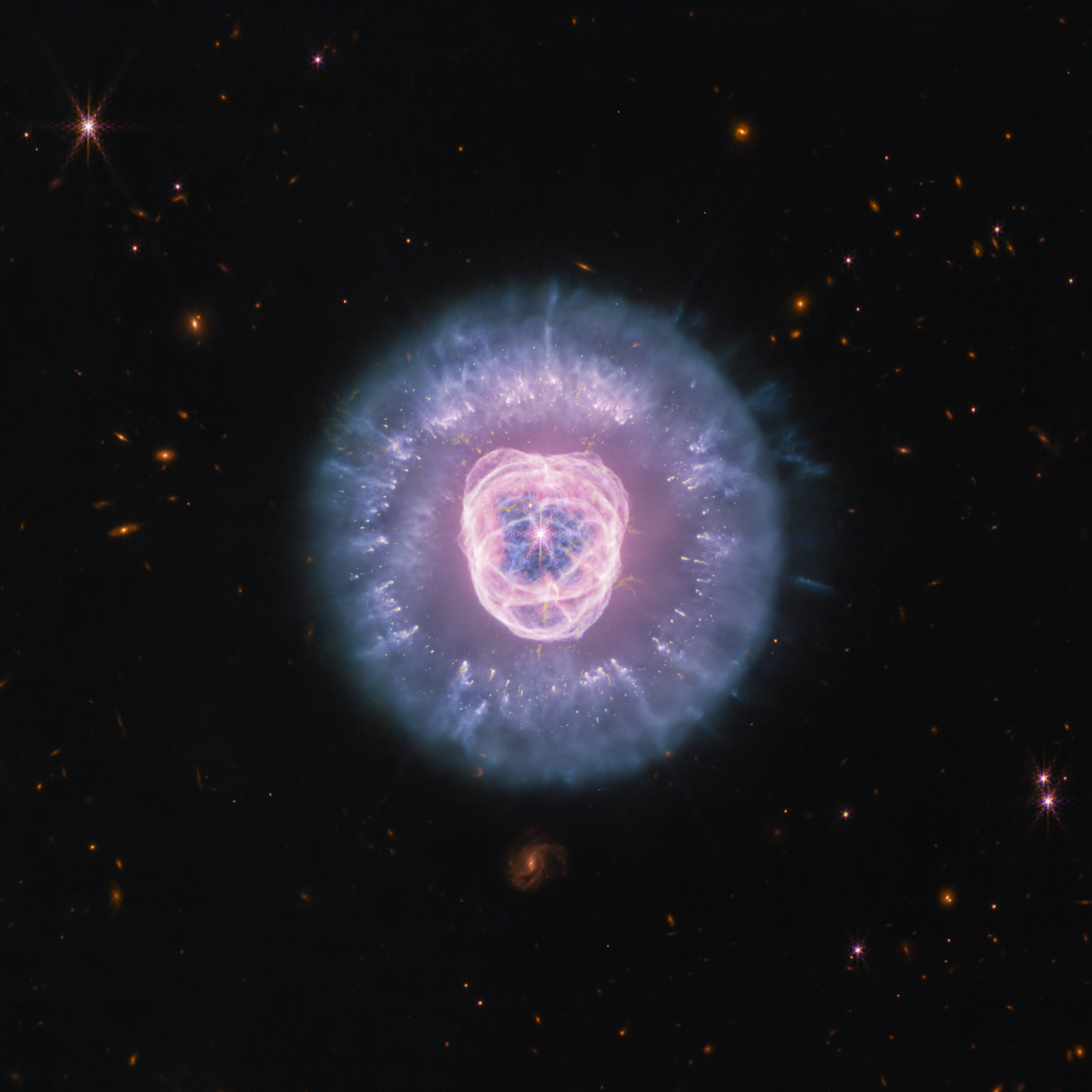
NASA's James Webb Space Telescope has produced its most detailed look yet at the Lion Nebula, a cloud of gas and dust shed by a dying, sun-like star, revealing for the first time which clumps of stellar debris are surviving the star's radiation and which are being destroyed. The images, released by NASA, the European Space Agency and the Canadian Space Agency, combine data from two of Webb's infrared instruments to map heat across the nebula's structure in unprecedented detail.
The nebula, cataloged as NGC 2392, sits roughly 6,000 light-years away in the constellation Gemini. It is the shrunken, energized remnant of a star that has exhausted its nuclear fuel: an oxygen-rich white dwarf now blasting radiation into the gas and dust it shed on its way out, carving a roughly circular, face-like bubble of ionized gas ringed by a sprawling, comet-streaked "mane." Astronomers estimate the entire structure will disperse within about 10,000 years, a brief flash on cosmic timescales, according to the Space Telescope Science Institute.
Webb's Near-Infrared Camera, or NIRCam, resolved compact clumps of dust and a haze of ionized gas with far more clarity than Hubble's visible-light images could manage. But it was the Mid-Infrared Instrument, MIRI, that supplied the real advance: a thermal map distinguishing dust that is hot, meaning it is actively being irradiated and destroyed by the white dwarf, from dust that is cooler and shielded, meaning it is surviving long enough to drift outward into interstellar space.
Rebuilding star systems
That distinction matters because stars between roughly one and eight times the mass of the Sun end their lives this way, swelling into red giants, shedding their outer layers and leaving behind a white dwarf rather than exploding as a supernova. The Sun itself is expected to follow the same path in about five billion years. By tracking which dust survives a dying star's radiation and which does not, astronomers can better estimate how much processed stellar material ultimately escapes to seed the next generation of stars and planets.
The observations were captured in November 2025 and processed for release by the Space Telescope Science Institute. Researchers say the same thermal-mapping technique could now be applied to other planetary nebulae to build a broader picture of how much of a dying star's material is recycled back into the galaxy rather than lost to radiation.