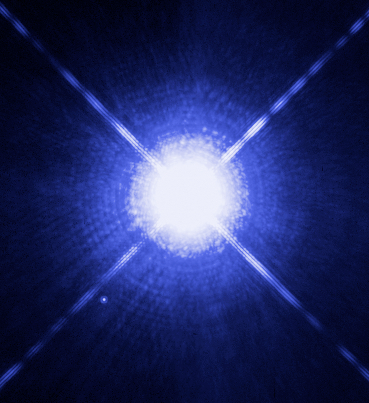
White dwarfs — the dense, burned-out cores left behind when stars like the sun die — can glow in colors far stranger than the blue-white hue usually associated with them, according to a new study from the University of Warwick. The researchers modeled how a sample of these stars would actually appear to a human eye and found examples that would look green, pink, cyan, yellow or purple.
The study, led by Dr. Mark Hollands with Professor Boris Gänsicke, was published in the journal RAS Techniques and Instruments under the title "Any colour you like: The diverse chromaticities of white dwarfs." No white dwarf is close enough for telescopes to resolve its disk directly, so the team instead took existing spectra — measurements of how much light a star emits at each wavelength — and ran them through a model of human color vision to predict how each star's light would actually look.
Most stars' colors are set almost entirely by temperature, which is why hot stars look blue and cool ones look red or orange. White dwarfs break that rule because their atmospheres are compressed to extraordinary densities, in the coolest cases approaching that of water. That density lets trace elements such as carbon, calcium and sodium absorb light across unusually broad bands of the spectrum, shifting a star's apparent color far from what its temperature alone would predict.
Sorted by chemistry, not just heat
The team grouped the unusual colors by what is polluting each star's atmosphere. White dwarfs with carbon-rich atmospheres tend to look pink or purple; those whose atmospheres have been contaminated by debris from shattered asteroids or comets tend toward yellow; and cooler stars with mixed hydrogen and helium can appear cyan or pale blue. One star, WD J1330+6435, had accreted rocky, sodium-rich material from its planetary system; the researchers' models give it a chartreuse-green hue, which they describe as the first genuinely green star identified. A second, WD J1011+2845, about 48 light-years from Earth, is colored salmon-pink by carbon dredged up from its interior and may be among the reddest stars ever recorded.
To gauge how common such stars are, the team modeled 151 white dwarfs within 20 parsecs of Earth — a volume of space mapped in detail by the European Space Agency's Gaia survey — and found five with unusual colors, or roughly one in thirty. The typical white dwarf in that sample worked out to a color temperature of about 6,800 Kelvin, which reads as plain white. The researchers note that brighter, bluer white dwarfs are disproportionately represented in surveys limited by how faint a star can be and still be detected, which may explain why white dwarfs are popularly pictured as uniformly blue-white.
Because the colors reported are modeled from spectra rather than captured in a photograph, the findings describe how these stars would appear to an observer rather than an image of them as seen through a telescope. The authors say the next step is searching larger surveys for more unusually colored white dwarfs to work out how common such atmospheric compositions really are.