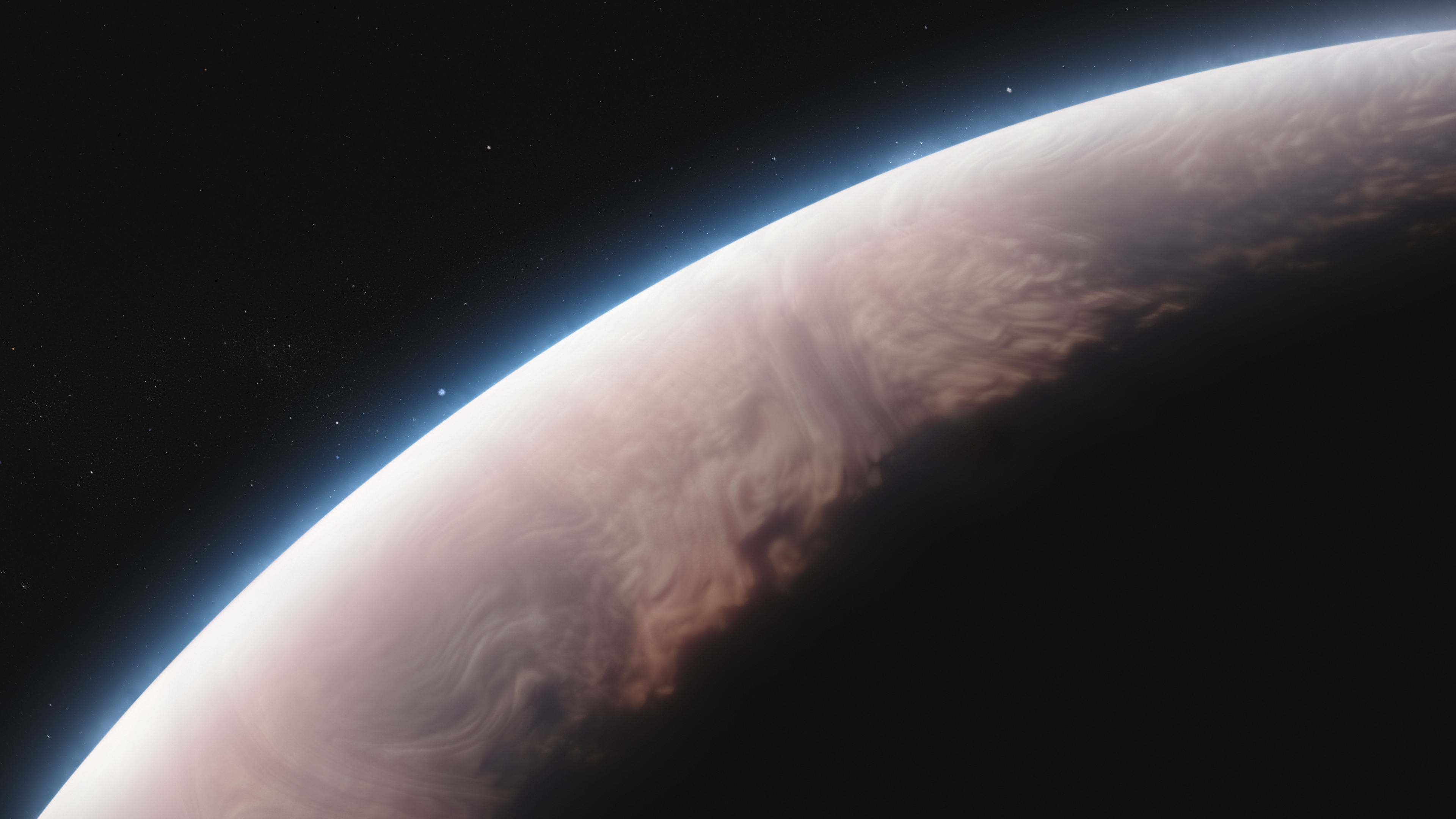
Astronomers have produced the first detailed map of weather patterns circling the edge of a planet outside our solar system, using a new technique applied to data from the James Webb Space Telescope. The target, a scorching gas giant called WASP-17b, turns out to have a lopsided atmosphere that puffs out more on one side than the other — exactly as decades-old theoretical models predicted.
The findings, published in Nature Astronomy, come from a method the team calls "transmission strings." Rather than averaging starlight into a single spectrum as WASP-17b crosses in front of its star, researchers tracked how the light changes at different points around the planet's silhouette, effectively slicing the atmosphere's edge into separate readings.
A world with weather
WASP-17b sits roughly 1,300 light-years from Earth and belongs to the "hot Jupiter" class of planets — gas giants that orbit so close to their stars that one side is perpetually roasted. The new map shows the planet's evening limb, the side rotating into the hottest, star-facing hemisphere, bulges outward as winds sweep scorching gas around from the dayside. The cooler morning limb stays more compact. The research was co-led by Cornell University and the University of Bristol, whose team developed the transmission-strings method.
Lead author Lili Alderson, a Klarman Postdoctoral Fellow at Cornell University, said the result shows that planets cannot be treated as simple flat disks.
"This is proof of concept that planets are in fact 3D objects."
Lili Alderson, Cornell University
Co-author Hannah Wakeford of the University of Bristol, who helped develop the technique, added that the atmosphere behaves unpredictably.
"Planets are temperamental, their atmospheres complex and chaotic."
Hannah Wakeford, University of Bristol
The planet has drawn scientific attention before: in 2023, Webb observations of WASP-17b's atmosphere turned up the first evidence of quartz crystals in the clouds of any exoplanet, a finding detailed in a NASA release at the time. The new study builds on that work by mapping structure around the planet's edge rather than averaging it away.
Limitations and next steps
The authors describe the result as a proof of concept tested on a single planet, and caution that it does not yet reveal unexpected chemistry: the measured temperature contrast between the morning and evening limbs matched existing theoretical predictions rather than overturning them. The technique could not reliably track how clouds or haze shift around the limb, and hints of methane near the planet's poles were not tightly constrained. The team, whose work drew on the JWST-TST DREAMS observing program, says the next step is applying transmission strings to more planets to see whether lopsided atmospheres are typical of the hot Jupiter class or a quirk of this one.